
Let’s talk about something every IT team deals with, but few really take the time to unpack: technical debt.
It’s not glamorous. It’s not exciting. But it’s everywhere.
You see it in slow onboarding processes, outdated deployment methods, fragile integrations, and the phrase that always follows: “We’ve always done it this way.”
Why Technical Debt Happens
Technical debt is like taking shortcuts in your code, infrastructure, or processes to meet an immediate goal, knowing that one day you’ll have to pay it back with “interest.”
And let’s be honest, those shortcuts usually start with good intentions.
- A team needed to meet a deadline.
- A project got green-lit before the foundational architecture was ready.
- Leadership changed direction mid-flight.
- Documentation was skipped to “save time.”
Multiply that by a few years, a few reorganizations, and a few dozen “quick fixes,” and suddenly you’re sitting on a mountain of outdated tech, manual steps, and fragile dependencies that no one fully understands anymore.
Why It’s So Hard to Reduce
The problem isn’t just the debt itself, it’s that the interest keeps compounding.
Fixing technical debt often feels risky because the systems it affects are business-critical. The code works (mostly). The servers still boot up. The deployment scripts still run if you hold your breath just right.
So teams rationalize:
“We’ll modernize next quarter.”
“We can’t touch that system, it’s too critical.”
“Let’s just patch it one more time.”
And every “one more time” pushes modernization further out of reach. The longer you wait, the harder it gets to make meaningful change.
How It Becomes an Anchor
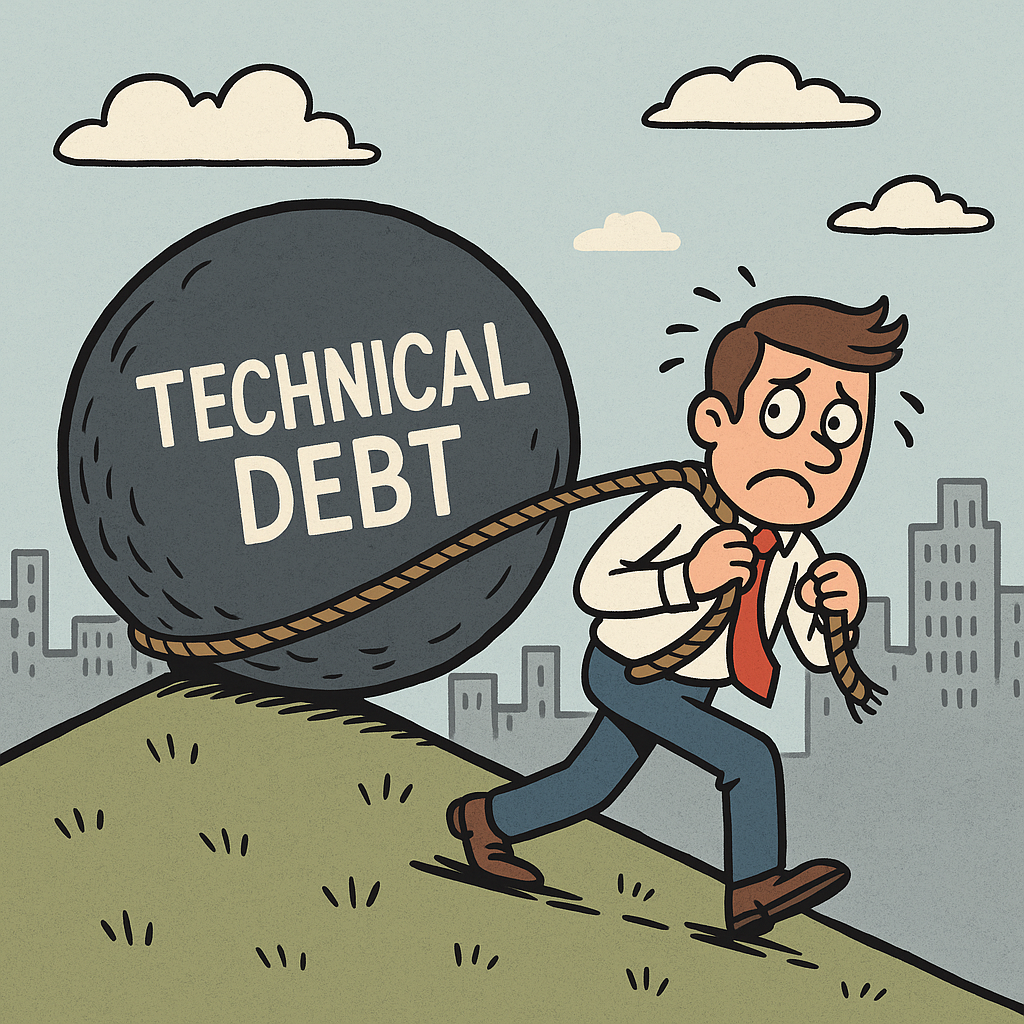
Here’s the real trap: technical debt doesn’t just slow you down, it locks you in.
It’s like trying to steer a ship with a rusted anchor still dragging on the ocean floor. You might move forward, but you’re fighting resistance at every turn.
For example, maybe your company wants to improve employee onboarding speed. Sounds simple, right? The target outcome is clear: new hires should get their laptops, access, and tools quickly so they can be productive from day one.
But then reality hits.
- Devices can’t be deployed unless they’re on the corporate LAN.
- You still rely on gold images that take hours to maintain and refresh.
- Your on premise Active Directory (AD) requires domain joins over SVPN, which doesn’t even work until the device is already configured.
- Workspace ONE, InTune, or any cloud management platform you want to use? Blocked by legacy GPOs or outdated naming conventions baked into scripts no one’s touched in years.
Suddenly, that “simple” modernization goal collides head-on with layers of accumulated debt.
You can’t move to drop-ship provisioning or zero-touch onboarding because the foundation underneath—identity, networking, and imaging—is built on old assumptions.
Examples of Technical Debt in That Scenario
| Area | Debt Example | Impact |
|---|---|---|
| Identity & Access | On-prem AD as the single source of truth; no Azure AD or cloud identity integration | Devices must connect via VPN or LAN to join domain, slowing onboarding |
| Deployment Method | Gold image maintained manually and updated quarterly | Outdated drivers, bloated software, inconsistent builds |
| Networking | Split-tunnel SVPN dependency | New hires can’t complete provisioning remotely |
| Policy Management | Dozens of legacy GPOs still active from Windows 7 era | Conflicts with cloud-based configuration profiles |
| Tooling & Processes | Manual ticketing for device prep, no automation for user provisioning | Delayed onboarding, wasted IT hours |
Each of those debts might have made sense once, but now they’re barriers to agility.
Breaking Free
You can’t pay off all your technical debt overnight, but you can start by changing the mindset, and that begins with ownership.
Too often, organizations play a game of hot potato with technical debt:
“That’s an ops problem.”
“That’s on the architecture team.”
“That’s for the PMO to figure out.”
Meanwhile, the problems stay right where they are.
The truth is, technical debt is everyone’s problem. It affects every part of IT: architecture, infrastructure, operations, security, and support. When one area carries the debt, the entire organization feels the drag.
That’s why ownership can’t live in a single silo. It has to be shared across IT and backed by executive sponsorship. Leadership must set the tone that paying down technical debt isn’t optional cleanup work; it’s an investment in agility, resilience, and future growth.
When ownership is clear, collaboration follows. Teams stop pointing fingers and start fixing problems together.
Here’s how that looks in practice:
- Acknowledge the debt openly. Make it part of the conversation, not a dirty secret.
- Assign ownership. Every system, process, and dependency should have a clear owner who’s accountable for its health.
- Quantify it. Document where the friction lives: manual steps, unsupported tools, dependencies, and broken workflows.
- Tie it to business outcomes. Instead of saying “we need to modernize AD,” say “this change will reduce onboarding time by 40%.”
- Start small but strategic. Automate a single process, pilot a modern management approach, and prove its value.
- Get executive sponsorship. Leadership buy-in transforms technical debt from a backroom IT concern into a company-wide priority.
When all of IT owns the problem collectively and leadership reinforces that alignment, paying off technical debt becomes not just possible, but inevitable.
In the End
Technical debt isn’t just a technical issue—it’s a business problem. It stifles innovation, frustrates employees, and prevents companies from pivoting when the market demands it.
Every organization wants to move faster, automate more, and modernize. But that can’t happen until they confront the invisible weight of the systems holding them back.
So the next time you hear someone say, “We’ve always done it this way,” or “We can’t do that because,” take it as a red flag and a reminder that it might be time to lift the anchor.