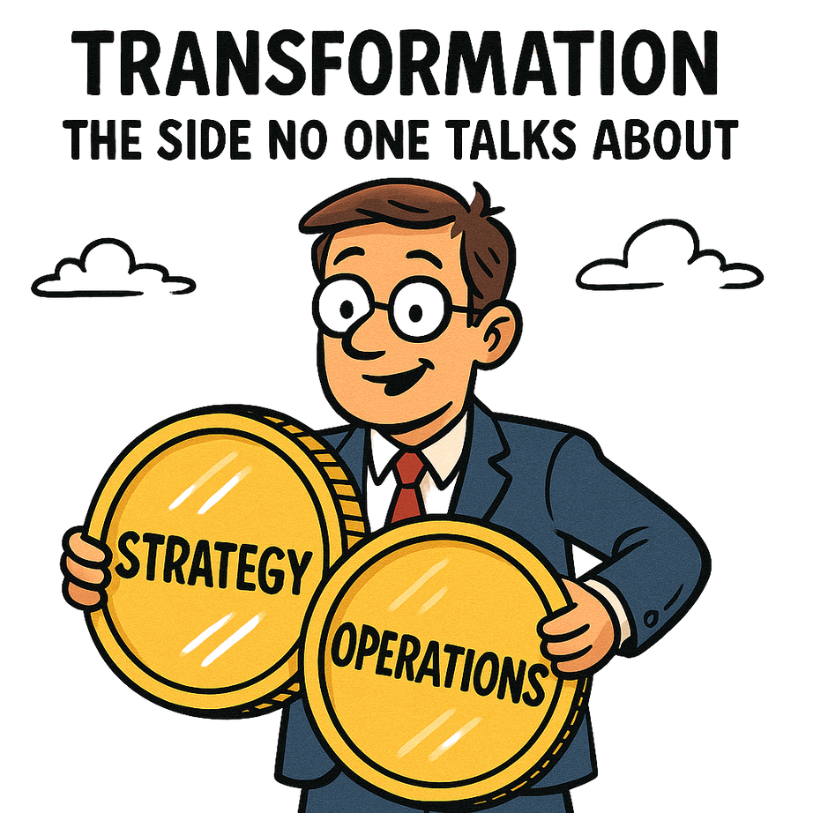
In my last post, I talked about transformation as a coin with two sides. On one side you have strategy: the exciting stuff like OGSM frameworks, metrics, and target outcomes. On the other side you have Day-2 operational readiness, which is the way you actually do IT.
Today, I want to flip the coin and focus on that second side.
There’s a famous saying: culture eats strategy for breakfast. And here’s the truth: culture isn’t what you put on a poster or in an email campaign. Culture is what you do. It’s your daily actions. You can have the sleekest strategy in the world, but if your actions (your culture) don’t align with it, your transformation is dead on arrival.
That’s why real transformation has to tackle both:
- A measurable, outcome-driven strategy
- The operational actions and culture to back it up
Miss one, and you’re sunk.
Why Transformation Efforts Fail
Most companies fail because they pick the flashy side of the coin. Strategy looks cool. Strategy gets the PowerPoints. Strategy makes pretty roadmaps and glossy diagrams.
But Day-2 operations? Not so sexy. That’s the grind: the back-to-basics, nuts-and-bolts work. Yet this is exactly where the battle for transformation is won or lost.
Getting Back to Basics
When I work with customers, we start by getting brutally honest about their current state. Not the “we think we’re good at this” version, but the actual state.
We measure it against ITIL standards, the gold standard for IT operations. We look at how they’re handling:
- Incident management
- Request management
- Problem management
- Event and monitoring
- Change management
- Operational governance
I run them through an interview-based questionnaire, which creates a scorecard across each area. From there, we do a gap analysis. And out of that, we build an action plan—a playbook for maturing their operational readiness.
Common Gaps
(and They’re Not Rocket Science)
Here’s the kicker: the gaps are usually simple.
- Fuzzy roles and responsibilities. Teams don’t know who owns what. Groups don’t talk to each other. Stuff falls through the cracks.
- Weak knowledge management. The help desk punts everything to senior engineers, who get buried. Why? Because no one has written down the fix, explained the routing, or created a knowledge base article.
And it’s not just small businesses. Massive enterprises wrestle with the same exact issues.
The fix? Back to basics. Define ownership. Write it down. Build the knowledge base. Empower the front line to actually solve tickets instead of escalating everything.
The 80/20 Truth of IT
Here’s something a lot of transformation architects don’t like to admit: 80% of IT is the unglamorous, mundane stuff. Break-fix. Firewall holes. Printer outages. Security baselines.
The cool, shiny projects? That’s maybe 20%.
But if you don’t get the fundamentals right—if your Day-2 operations aren’t mature—that 20% will never deliver the value it should.
The Bare-Bones Formula for Transformation
So here it is: transformation works when you tackle both sides of the coin.
- Strategy: measurable outcomes, metrics, direction
- Operations: culture, daily actions, foundational IT practices
Ignore one, and you’ll fail. Embrace both, and you’ve got a shot at something that sticks.
It’s not sexy. It’s not flashy. But it’s what separates organizations that spin their wheels from those that actually evolve.