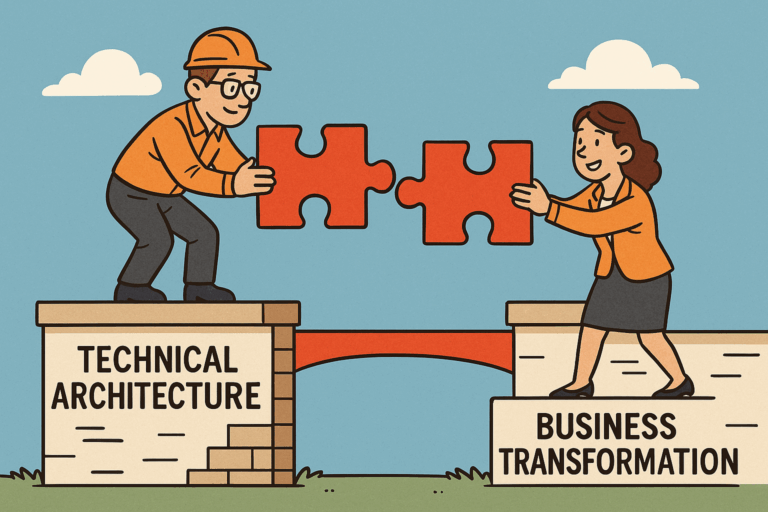
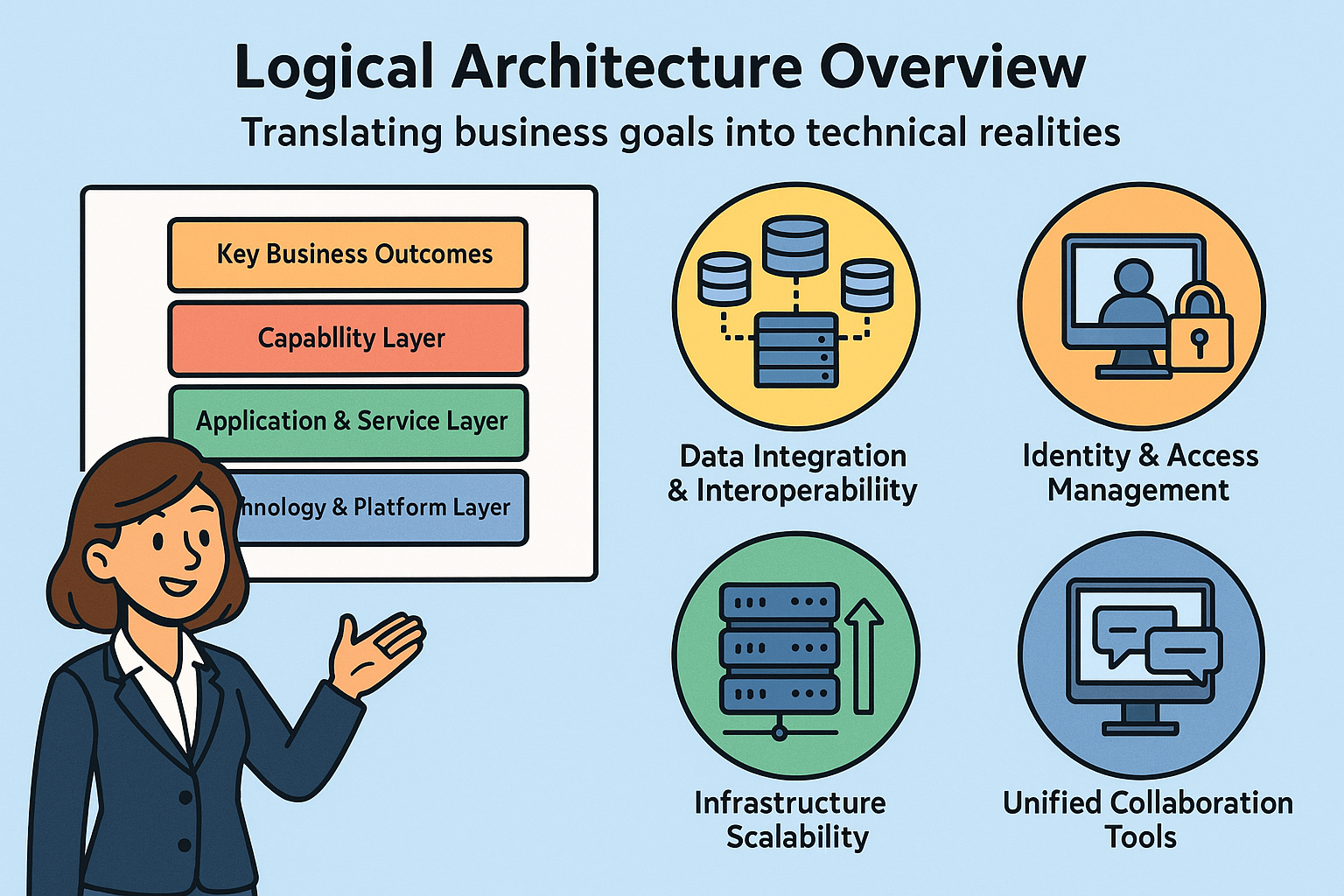

In our previous post, we explored what ABC Health Now needs to achieve. Now, we’re zooming in on how IT makes that happen by translating business goals into technical realities.
A logical architecture is important in mergers and acquisitions because it provides a clear blueprint of how IT capabilities, systems, and data should integrate, ensuring seamless onboarding of new entities. It helps align technology with business goals, reduce integration risks, and accelerates the realization of operational and financial synergies.
As ABC Health Now strives to achieve accelerated integrations, we shift focus to how IT delivers those capabilities. By mapping key capabilities from the conceptual IT architecture like data integration, identity and access management, scalable infrastructure, and unified collaboration tools to the processes needed for rapid onboarding and system harmonization.
Ultimately, it accelerates ABC Health Now’s ability to capture market opportunities, realize synergies, and maintain high-quality care across newly acquired facilities.
- Logical Architecture Overview: We begin by identifying and understanding the business outcomes necessary for accelerated post-merger integration and operational readiness.
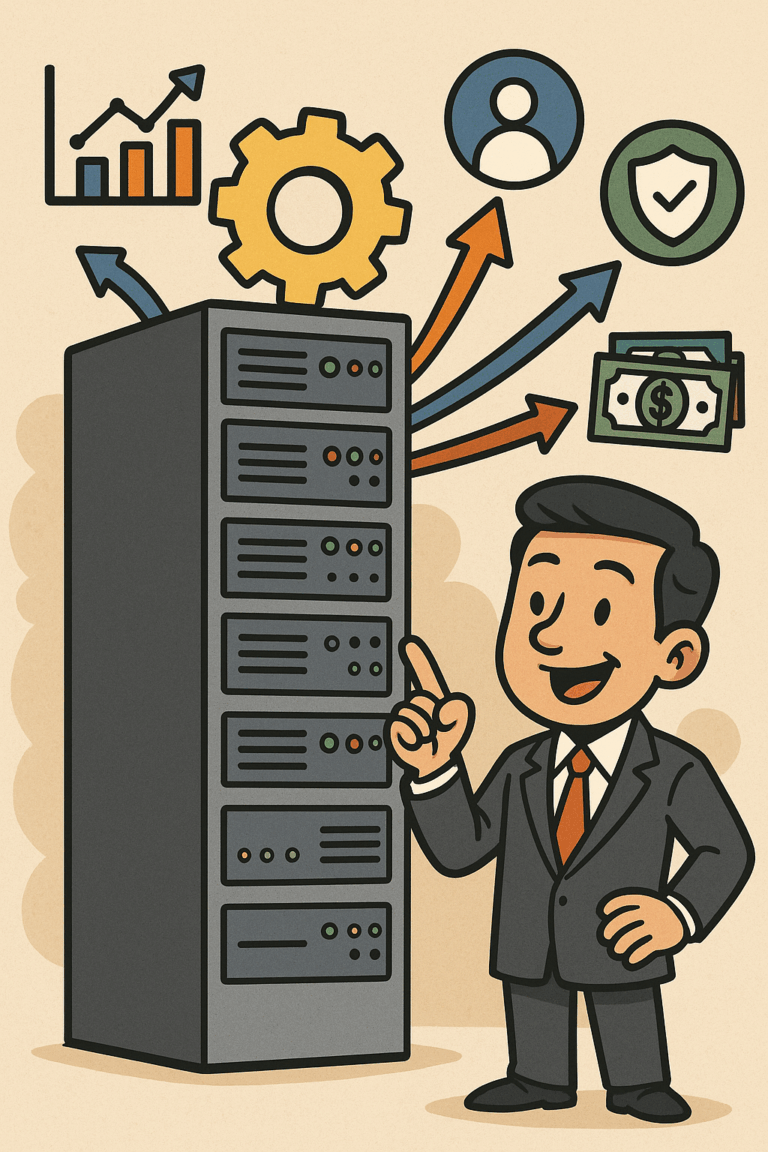
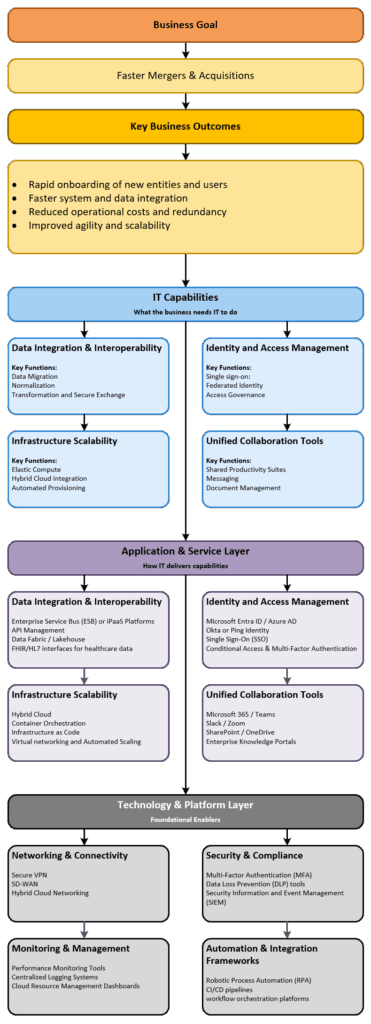
- Key Business Outcomes: Key business outcomes represent measurable results that directly contribute to achieving a broader business objective. They translate strategic goals into tangible performance indicators that show progress toward overall organizational success.
- Rapid onboarding of new entities and users: Integrate acquired organizations’ staff, systems, and processes which minimize downtime and operational disruption to shorten merger timelines.
- Faster system and data integration: Quickly connect newly acquired facilities’ IT systems, ensuring operational continuity and reducing interruption which accelerates onboarding.
- Reduced operational costs and redundancy: By reducing operational costs and eliminating redundant systems, ABC Health Now can allocate resources more efficiently to integrate newly acquired entities.
- Improved agility and scalability: Quickly integrate new systems, applications, and teams from acquired organizations without major delays or infrastructure bottlenecks.
These outcomes streamline post-merger processes, accelerates operations, and enables the company to realize synergies, capture market opportunities, and achieve business value more quickly.
Capability Layer
(What the business needs IT to do):
Here we shift from describing what capabilities are needed to how those capabilities are structured in IT terms. The capability layer expands what was defined in the conceptual IT architecture with core functions required to support rapid business integration. It translates business needs into actionable IT capabilities that enable rapid system unification, operational continuity, and agility during organizational growth.
Data Integration & Interoperability:
Allows rapid consolidation and standardization of data from newly acquired entities, ensuring accurate and consistent information across systems. It enables seamless communication between disparate applications and platforms, reducing delays in workflows and decision-making to provide a unified data environment.
Key Functions
Data Migration: Accelerate post-merger integration by quickly moving critical data from acquired systems into the central IT environment, minimizing downtime and ensuring continuity.
Normalization: Ensure data from disparate sources follow consistent formats and standards, enabling seamless analysis and reducing errors during integration.
Transformation and Secure Exchange: Allow data to be reshaped for compatibility across systems while protecting sensitive information, ensuring reliable, compliant, and efficient operational readiness.
Identity & Access Management (IAM):
Quickly and securely provisioning unified user identities and access across all merged systems, enabling seamless collaboration and reducing onboarding delays.
Key Functions
Single sign-on: Allow users from newly acquired entities to access all necessary systems with one set of credentials, reducing onboarding time and IT support overhead.
Federated Identity: Enable secure authentication across different organizations’ directories, ensuring seamless access to shared resources without duplicating accounts or compromising security.
Access Governance: Ensure users have the right permissions based on their roles, minimizing security risks while enabling rapid, compliant operational readiness across the merged organization.
Infrastructure Scalability:
Rapid provisioning of compute, storage, and network resources across merged entities, allowing systems and applications to be integrated quickly and operational readiness to be achieved without delays or bottlenecks.
Key Functions
Elastic Compute: Enables the organization to quickly scale processing power up or down to handle increased workloads from newly acquired entities without delays.
Hybrid Cloud Integration: Provides seamless connectivity between on-premises and cloud systems, ensuring that data and applications from merged organizations can be accessed and shared efficiently.
Automated Provisioning: Speeds up the deployment of servers, applications, and user accounts, reducing manual effort and accelerating the onboarding of new business units.
Unified Collaboration Tools:
Provide a centralized, secure platform for seamless communication, document sharing, and coordinated workflows across newly merged teams.
Key Functions:
Shared Productivity Suites: Streamline collaboration providing a common workspace where teams from merged entities can access, edit, and co-author documents in real time.
Messaging: Enable instant communication across departments, reducing delays, clarifying decisions, and keeping integration tasks on track.
Document Management: Ensure consistent storage, version control, and secure access to critical records, preventing information loss and accelerating operational readiness.
Application & Service Layer
(How IT delivers these capabilities)
The Application & Service Layer implements what is defined in the capabilities layer by providing the specific tools, platforms, and services that enable the business to achieve IT-driven objectives. This focus ensures a clear mapping between business goals and IT solutions, guiding technology decisions, reducing complexity, and accelerating the realization of streamlined acquisition strategies.
Data Integration & Interoperability
Enterprise Service Bus (ESB) or iPaaS Platforms: Platforms like MuleSoft and Boomi provide a unified framework to connect disparate systems across merged organizations, enabling seamless data flow and reducing manual integration work. This allows IT teams to map, transform, and synchronize data between legacy and new systems quickly, accelerating system onboarding.
API Management: Solutions such as Azure API Management or Apigee, create secure, standardized interfaces for accessing data and services across organizational boundaries, ensuring consistent and controlled integration. By exposing services via APIs, these platforms simplify the integration of applications and reduce dependency on point-to-point connections, which speeds up operational readiness.
Data Fabric / Lakehouse: A data lakehouse is a unified architecture that combines the flexible storage of all data types in a data lake with the structured management of a data warehouse, while a data fabric is a distributed architecture that connects and unifies data across environments, ensuring consistent access and management regardless of location. These architectures, like Databricks or Snowflake, centralize and harmonize data from multiple sources, providing a single source of truth for reporting, analytics, and decision-making. They enable real-time or near-real-time data access, helping leadership quickly assess performance and operational gaps in newly acquired entities.
FHIR/HL7 interfaces for healthcare data: Fast Healthcare Interoperability Resources (FHIR) is a modern data standard for exchanging healthcare information developed and managed by HL7 International. HL7 develops various healthcare interoperability standards to facilitate data sharing between different systems. These interfaces standardize the exchange of healthcare-specific data, allowing clinical and administrative systems from different organizations to communicate without delays or errors. Collectively, these applications and services streamline data integration, improve interoperability, and ensure merged organizations operate cohesively and efficiently quickly corporate mergers.
Identity & Access Management
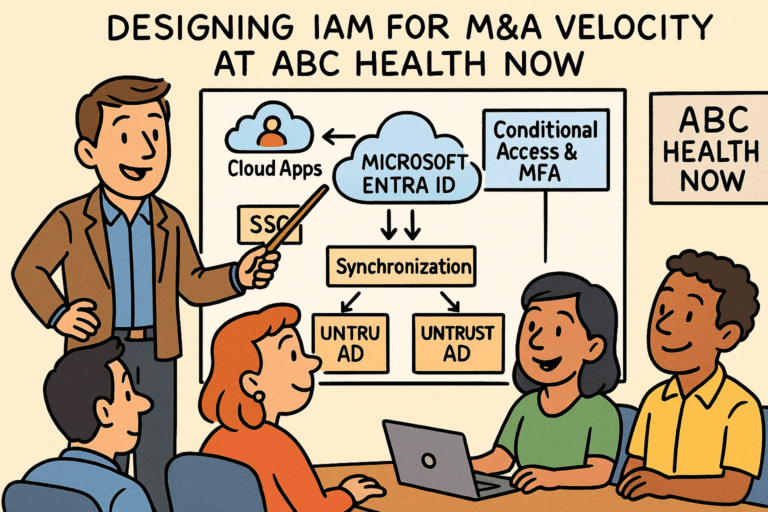
Microsoft Entra ID / Azure AD: This platform provides a centralized identity platform that enables rapid onboarding of new employees from acquired organizations.
Okta or Ping Identity: These solutions offer federated identity solutions that allow users from different systems to authenticate seamlessly across merged entities.
Single Sign-On (SSO): Reduced complexity of managing multiple credentials, enabling employees to access all necessary systems immediately after onboarding.
Conditional Access & Multi-Factor Authentication (MFA): Ensure access to sensitive resources is granted based on risk factors such as device compliance, location, or user behavior, enhancing security during integration. (MFA) adds an additional layer of protection, preventing unauthorized access while maintaining smooth access for legitimate users.
These services minimize delays in granting the right access, which accelerates operational readiness for new business units. They also reduce administrative overhead by automating user provisioning, deprovisioning, and access management.
Infrastructure Scalability
Hybrid Cloud: Platforms like Azure, AWS, and GCP provide flexible and on-demand compute and storage resources, allowing newly acquired systems to be quickly hosted without waiting for physical hardware.
Container Orchestration: Tools such as Kubernetes and OpenShift standardize deployment environments, enabling consistent and rapid application rollout across multiple sites.
Infrastructure as Code: Tools like Terraform and Ansible automate provisioning and configuration of servers, networks, and services, reducing manual errors and speeding up integration.
Virtual networking and Automated Scaling: Ensures secure connectivity between legacy and newly acquired systems, facilitating seamless communication and data exchange. Automated scaling dynamically adjusts resources to meet workload demands, preventing downtime during high-traffic periods.
Unified Collaboration Tools
Microsoft 365 / Teams: Provide a unified workspace where newly merged teams can communicate, schedule meetings, and share documents in real time, reducing delays caused by fragmented communication systems.
Slack / Zoom: Complement this by offering instant messaging and video conferencing, enabling quick decision-making across geographically dispersed teams.
SharePoint / OneDrive: Allow secure document storage and version control, ensuring that all team members have access to the latest information during integration.
Enterprise Knowledge Portals: Centralize organizational knowledge, policies, and best practices, helping new employees quickly understand workflows and corporate standards.
Technology & Platform Layer
(Foundational Enablers)
The technology & platform layer provides the foundational infrastructure like security, and automation that enable the application & service Layer to deliver IT capabilities. This ensures clear alignment between business goals and IT services, allowing reduced complexity, and more predictable outcomes.
Networking & Connectivity: This layer enables Infrastructure Scalability capabilities by ensuring secure, reliable, and high-performance connections between on-premises systems, cloud resources, and newly acquired entities. Examples include SD-WAN for optimized wide-area connectivity, VPNs for secure remote access, and hybrid cloud networking to link multiple cloud environments with on-premises data centers. This is critical to the overall logical architecture because without robust networking, scalable infrastructure cannot be effectively provisioned, systems cannot integrate seamlessly, and teams across merged organizations cannot collaborate efficiently.
Security & Compliance: Identity & Access Management (IAM) is supported by this layer because it ensures only authorized users and systems can access sensitive data and resources across merged entities. It is also critical for Data Integration & Interoperability, protecting data during migration and exchange between systems, and for Infrastructure Scalability, securing cloud and on-premises resources as they expand. Examples include Multi-Factor Authentication (MFA), Data Loss Prevention (DLP) tools, and Security Information and Event Management (SIEM) systems. These essential systems maintain regulatory compliance, prevent breaches, and ensure that mergers do not introduce vulnerabilities.
Monitoring & Management: These functions are associated with Infrastructure Scalability, as they ensure cloud resources, virtual environments, and applications perform reliably and scale efficiently during business consolidations. Examples include performance monitoring tools like Datadog and New Relic, centralized logging systems like ELK Stack and Splunk, and cloud resource management dashboards like those found in AWS CloudWatch and Azure Monitor) This capability is crucial to the overall logical architecture because it provides visibility, ensures system uptime, enables proactive issue resolution, and supports seamless integration of new entities.
Automation & Integration Frameworks: These Frameworks enables Data Integration & Interoperability and Infrastructure Scalability by automating repetitive tasks, orchestrating workflows, and connecting disparate systems efficiently. Examples include Robotic Process Automation (RPA) tools like UiPath, CI/CD pipelines with Jenkins or GitHub Actions, and workflow orchestration platforms like Apache Airflow or Azure Logic Apps. This is critical to the overall logical architecture because it reduces manual errors, ensures consistent system provisioning, and enables faster realization of business value.
With this logical foundation in place, we can now explore how it shapes the organization’s support model, event monitoring and alerting, and identity and access management, which are the operational engines that turn architecture into action.
Next time, we’ll take this a step further and explore how the logical architecture connects to real-world support models where theory meets daily IT operations.