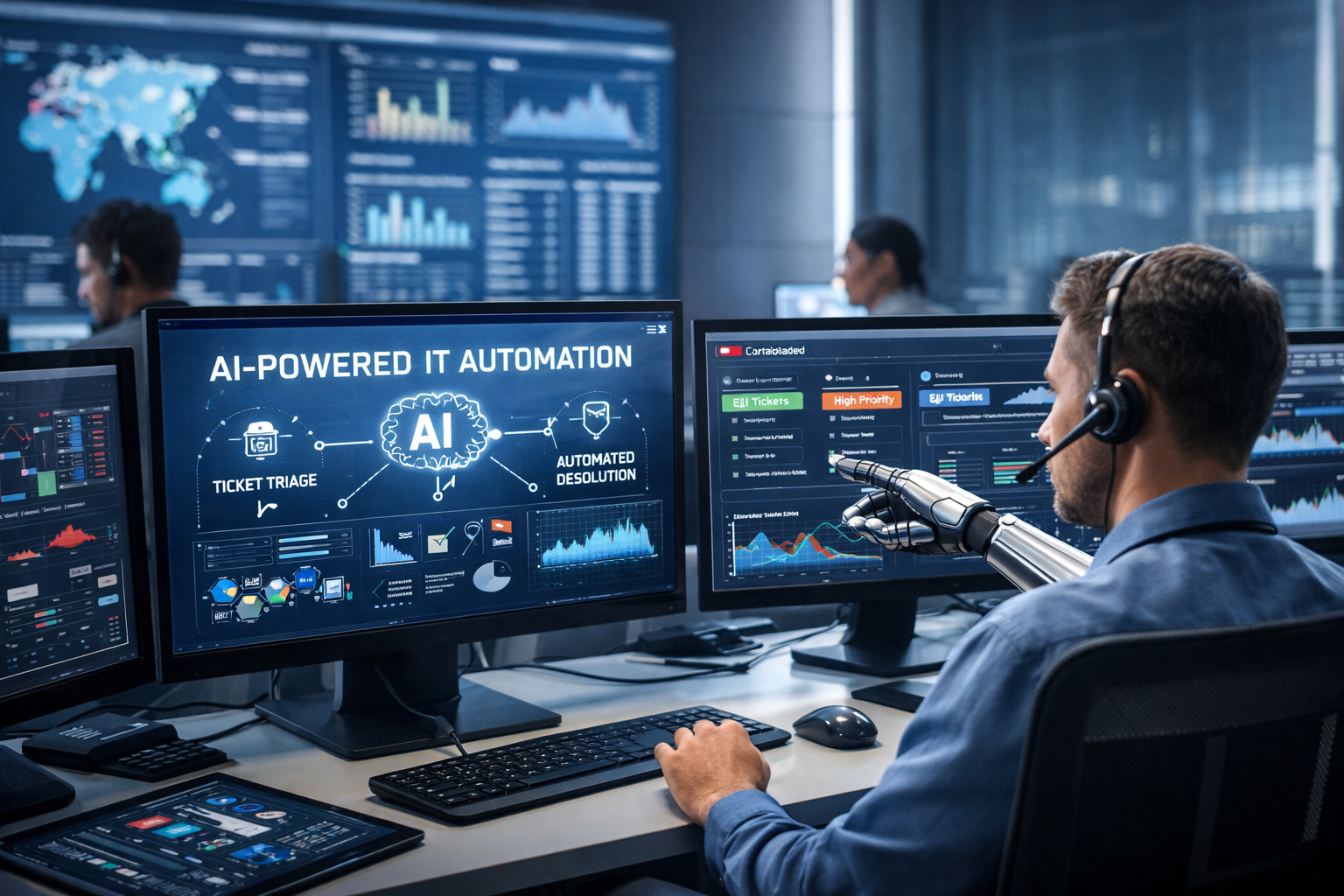
IT leaders are under increasing pressure to improve service reliability while managing growing ticket volumes and constrained resources. Business automation has long been a priority for IT organizations, and AI has emerged as the most impactful accelerator of that strategy. By automating ticket triage, improving categorization, and aggregating incidents into actionable patterns, AI enables support organizations to move beyond reactive firefighting and toward proactive, insight-driven operations. This article explores practical ways executives can apply AI today to streamline business automation tooling, strengthen incident response, and deliver faster, more consistent outcomes across IT operations.
Automate Ticket Intake and Normalization
Action: Use NLP (Natural Language Processing) models to parse incoming tickets from email, chat, portal, and monitoring tools.
How it helps: This allows IT teams to automatically extract key details such as affected service, symptoms, urgency, and context from unstructured information. Normalization standardizes inconsistent language (“VPN down” vs. “can’t connect remotely”) and formats it into structured data, reducing ambiguity and manual interpretation. As a result, tickets enter the system accurately classified and enriched, enabling faster routing, prioritization, and resolution.
Implementation tip: Start with pre-trained NLP models fine-tuned on historical ticket data from your ITSM platform (ServiceNow, Jira Service Management, Freshservice).
AI-Driven Categorization and Priority Scoring
Action: Use supervised ML (machine learning) models to auto-assign category, subcategory, and priority.
How it helps: Using models trained on historical ticket data enables automatic assignment of category, subcategory, and priority based on patterns of past incidents. This ensures consistent classification and more accurate priority scoring by factoring in impact, urgency, and resolution outcomes rather than subjective human judgment. Consequently, tickets are routed correctly on first touch, SLA risk is reduced, and overall resolution times improve.
Implementation tip: Train models using closed tickets with resolution labels (category, assignment group, SLA breach status).
Intelligent Assignment Routing
Action: Route tickets using AI based on skill matching, workload, and historical resolution success.
How it helps: Routing tickets using AI ensures that each issue is assigned to the engineer or team most capable of resolving it efficiently. This approach balances workloads across support staff, prevents bottlenecks, and reduces the time spent reassigning tickets. Directing tickets to the right resource on the first attempt, resolution speed increases, and overall service quality improves.
Implementation tip: Incorporate resolution time and reopen rates as feedback signals to continuously improve routing accuracy.
Incident Clustering and Deduplication
Action: Apply clustering algorithms to group related tickets and alerts into a single incident.
How it helps: Applying clustering algorithms allows IT teams to identify multiple reports stemming from the same underlying issue. This deduplication reduces noise (alert fatigue), prevents redundant work, and consolidates information for a clearer understanding of the incident. By creating a single, unified incident record, response teams can coordinate remediation more efficiently and accelerate resolution.
Implementation tip: Cluster on shared attributes such as error signatures, affected services, timestamps, and user location.
Early Incident Detection and Correlation
Action: Correlate tickets with monitoring, logs, and telemetry using AI.
How it helps:
- Detects incidents before volume spikes occur.
- Links user-reported issues to infrastructure or application events.
- Improves root cause identification speed.
Correlating tickets enables IT teams to detect patterns and anomalies that indicate emerging incidents. This correlation links user-reported issues with underlying infrastructure/system events, helping identify root causes faster and before problems escalate. This enables IT teams to proactively respond, improve root cause identification speed, minimize downtime, and reduce the overall impact on users and services.
Implementation tip: Integrate APM, infrastructure monitoring, and identity systems into the correlation engine for richer context.
Automated Response and Resolution Suggestions
Action: Attach AI-generated remediation steps to tickets at creation.
How it helps: Attaching AI-generated remediation steps provides immediate, context-aware guidance to IT staff, reducing the time spent diagnosing common issues. It enables Tier 1 support to automatically resolve routine problems without human intervention, freeing engineers to focus on more complex tasks. This approach improves consistency, accelerates resolution, and ensures that best practices are applied across all incidents.
Implementation tip: Use past successful resolutions and runbooks as training data, with guardrails for human approval.
Continuous Learning and Feedback Loops
Action: Feed resolution outcomes back into models automatically.
How it helps: Updating the AI models with resolution outcomes allows the system to learn from past successes and mistakes, continuously improving its accuracy in ticket classification and suggested actions.
This feedback loop helps the models adapt to new applications, changing environments, and emerging incident patterns, preventing performance degradation over time. IT teams will benefit from more reliable predictions, faster resolutions, and increasingly effective automated support.
Implementation tip: Track misclassification rates, reassignment frequency, and SLA breaches as model performance indicators.
Executive and NOC Visibility
Action: Use AI to generate real-time incident summaries and trend analysis.
How it helps: Using AI for summarization and trending provides executives and NOC teams with clear, concise insights into current and emerging issues without manual data aggregation.
It highlights systemic patterns, recurring incidents, and service impacts, enabling more informed decision-making and proactive response planning.
This visibility improves situational awareness, streamlines shift handoffs, and helps minimize downtime and operational disruption.
Implementation tip: Auto-generate incident narratives and impact summaries directly from clustered data.
AI transforms ticket triage from a manual sorting function into an intelligent signal-processing layer, reducing noise, accelerating resolution, and enabling IT teams to focus on systemic improvements rather than reactive work. As AI automates routine tasks, traditional Tier 1 and 2 support roles will likely shift toward system design, automation oversight, exception handling, and AI governance. Tier 1 and 2 support individuals can adapt by shifting their focus from manual task execution to higher-value activities like:
Developing AI Oversight Skills: Learn to monitor, validate, and fine-tune AI-driven tools to ensure accurate ticket triage, categorization, and automated remediation.
Focus on Exception Handling: Concentrate on complex or unusual incidents that AI cannot resolve, providing human judgment and context-aware decision-making.
Enhance Technical Expertise: Expand knowledge in system design, automation scripting, and platform engineering to contribute to the creation and maintenance of AI-driven processes.
Improve Soft Skills: Strengthen communication, collaboration, and problem-solving skills for situations where AI provides recommendations, but humans make final decisions.
Engage in Continuous Learning: Stay current on AI capabilities, IT trends, and emerging technologies to maintain relevance in a changing support landscape.
By embracing these areas, Tier 1 and Tier 2 staff can transition from routine problem-solving roles to strategic, specialized positions that complement AI and increase long-term career value.
IT has never been an industry of stagnation, and the introduction of AI is the latest example of continuous change.